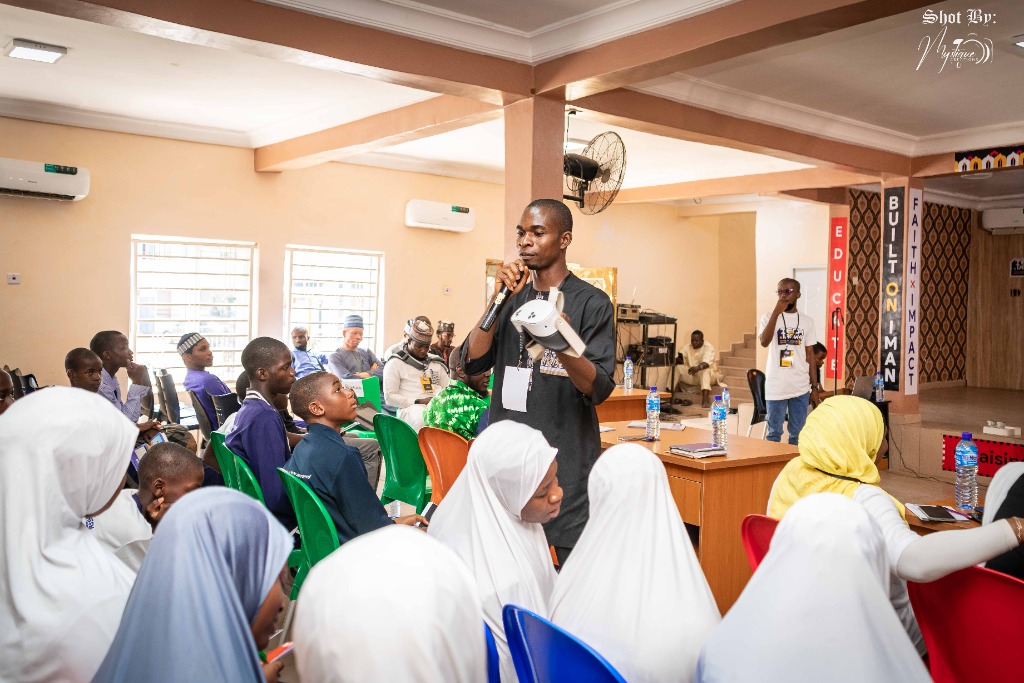
Tech with Taqwa 2025 — Seeing the Future: AR/VR in Education
There is something uniquely powerful about speaking to secondary school students. They have not yet been told what is impossible. That energy was alive in every corner of the room at Tech with Taqwa 2025.
Tech with Taqwa is an event that brings together two things that might seem separate on the surface — technology and faith — and makes the case that they belong in the same conversation. Held in Ilorin on February 11th, 2025, the event gathered secondary school students under a theme that is as relevant as it is inspiring: that the pursuit of knowledge, including technological knowledge, is inseparable from purpose, integrity, and consciousness. That is what Taqwa means — not just piety, but a deep, guiding awareness in everything you do.
I was invited to speak on a subject that sits at the heart of what I do: how Augmented Reality, Virtual Reality, and games are reshaping the way we learn. Not as a distant, futuristic idea — but as something real, accessible, and already happening right now.
The talk was titled "Seeing the Future," and it opened with a question designed to make the room sit up: What if you did not have to imagine a chemistry experiment — what if you could just walk into one?
From that opening, we built a conversation around why traditional education sometimes struggles to reach students. Textbooks describe things; immersive technology lets you experience them. There is a fundamental difference between reading about how molecules bond and watching it happen in three dimensions around you.
One of the most impactful examples I walked the students through was the Euler Virtual Chemistry Lab — a fully immersive VR application that places students inside a real-looking laboratory environment. In it, you can mix chemicals, run experiments, and observe reactions — all without a physical lab, costly equipment, or safety hazards. For a student in a school with limited science resources, this is not just interesting — it is genuinely life-changing access.
We also explored how game-based learning is far more than entertainment. Games build persistence, teach cause-and-effect reasoning, and reward curiosity — traits that map directly onto how great thinkers and problem-solvers are made. The point landed clearly: play is not the opposite of learning. For the right mind, play is exactly how learning happens best.
But the moment that brought everything to life — the one that made the room erupt — was the live VR demonstration. I brought out the headset, and students queued up. One by one, they slipped it on and stepped into a virtual world. For most of them, it was their very first time experiencing VR. Watching each student go from wide-eyed uncertainty to pure wonder in a matter of seconds was a reminder of exactly why this technology matters. It does not just impress — it opens a door in the mind that does not close again.
By the end, the room was buzzing. The questions were not just about VR and AR — they were about how to build, where to start, and what was possible for young people right now. That is always the goal.
It was a privilege to stand in that room with those students. The people who will shape the next era of immersive technology are still in secondary school classrooms right now — and events like Tech with Taqwa remind us that the best builders are also guided by something greater than the technology itself.